$24.95/mo.
300 Mbps
$35/mo.
300 Mbps*
$20/mo.
100 Mbps
25–150Mbps
Columbus runs on neighborhoods. Locals say Cbus, the 614, or just German Village or Franklinton. The city has about 938,000 residents and over 62,000 students on Ohio State's Columbus campus alone. New jobs keep arriving, too. That mix means no two homes need the same connection. This guide shows what to know before choosing, from speeds and prices to the blocks each service actually reaches.
Columbus got its Arch City name from the arches over High Street around 1900. Think of providers as arches. Each one covers some ground and leaves some open.
AT&T is the strongest fiber provider, but it doesn't cross every street. Where it does, the fast, equal upload suits video-call-heavy workdays. EarthLink is another option, but it relies on partner lines, so it's best to check first.
Spectrum and Breezeline are the city's everyday bridges. Both reach roughly nine in ten addresses. For budget-minded homes, that's the safest path, as long as the post-promo bill is clear.
Fixed wireless suits a city where most people rent. Verizon 5G Home, AT&T Internet Air and EarthLink 5G Home Internet come with no contract and easy setup. T-Mobile's version is also available. Coverage is partial, so it's worth a quick check.
Starlink and Viasat sit at the corners of the map. They're handy if nothing else reaches.
347.09 Mbps
32.84 Mbps
19 ms
25
Average speed rate as per Ookla’s Speedtest results for 2026
Enter your zip code to get a list of top internet providers serving your neighborhood. Compare speeds, prices, features, and plans, and select the best option for your home.
Fiber internet uses glass strands to carry the signal, which means steady speeds and very little lag. In Columbus, fiber shows up most in central neighborhoods. But AT&T Fiber coverage swings widely by address. One street may have it while the next one doesn't.
Best for:Columbus has a real duopoly between Spectrum and Breezeline for wired connection. That keeps promo prices competitive, and most addresses get a choice. Download speeds are strong. Uploads lag, so heavy video callers may feel it.
Best for:Fixed wireless sends a home internet signal from cell towers to a small gateway. There's no cable run and no wait for a crew. Renters like that. The trade-off is that speeds depend on signal and tower traffic, so results can shift by block.
Best for:Here's what's moving around town. Verizon finished buying Frontier in January 2026. In Columbus, Frontier is a small, address-by-address story.
Local leaders are betting on access. The city and county committed $20.2 million to close the digital gap. The county added $5 million for the years after 2027. The target is better home internet for roughly 80,000 households.
Statewide, Ohio's $793 million BEAD plan was approved in December 2025. It focuses on unserved places, mostly outside cities. Meanwhile, the ACP is gone. Lifeline and provider discounts are what's left for many Columbus households.
If your street has AT&T Internet, take it. Matching upload and download speeds are a big deal for hybrid workers in the urban core. If it isn't there yet, don't force it. HFC and cable does the job well.
Spectrum is the default here. It reaches more than 90%% of the city and is almost always available, even in older buildings. Keep an eye out for changes in promos and prices since Spectrum recently acquired Cox.
This one's a good fit for a city of renters. It involves no wires, no contract, and is pretty quick to set up. T-Mobile's version competes here too. Coverage is partial, so confirm your block.
$50/mo.
300 Mbps
Price + taxes & fees for new customers after discounts w/elig AutoPay & Paperless bill. Ltd. avail/areas.
$30/mo.
100 Mbps
For 1 year. for terms and conditions.
$35/mo.
300 Mbps*
w/ Auto Pay & any Verizon mobile phone plan .
*Typical speeds of 85-250 Mbps
Think hybrid workers in the Short North and Italian Village, and AT&T will stand out for its fiber connection here. Back-to-back video calls and big uploads feel smoother when upload matches download.
Spectrum Internet, on the other hand, fits Clintonville and Northland families where several people stream at once. It reaches most of the city, so it's easy to get.
Then come the renters and students who want speed without a cable install, who are likely to find Verizon 5G home internet a more reliable option. Signal varies by block and other factors such as proximity to the pole. So it's best to test first.
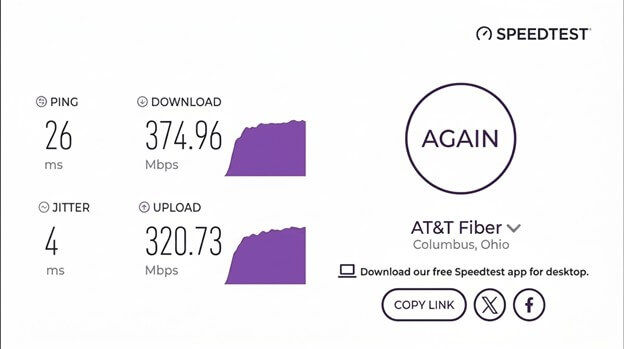
A verified speed test from an AT&T Fiber user in Columbus shows 374.96 Mbps down and 320.73 Mbps up. That balance is the real story. Uploads this close to downloads keep video calls clear and cloud backups quick. Latency of 26ms keeps gaming and calls smooth, even with several devices online.
See How Fast Your Connection Really IsBudget-friendly internet for the Arch City
Rent takes a big slice of many Columbus paychecks. Internet shouldn't take another. Three providers keep costs in check here: Breezeline, Spectrum, and Verizon 5G Home. Each fits a different kind of household. Start with the starting price, then check what the bill becomes later.
This internet provider often opens with the lowest starting price in Columbus, and it reaches most of the city. That makes it a smart pick for renters on a tight budget. It also offers a price guarantee on the cheapest plan to offer maximum security.
This one works well as a no-contract fallback in Columbus. It skips the wire, so setup takes minutes. Coverage is partial, though, and it varies by block. A quick address check shows whether your street gets a strong signal. Movers like that freedom.
Spectrum covers almost the whole city and adds Spectrum Internet Assist for qualifying households. That helps in a city where rent covers a huge chunk of your monthly pay. Ask about the program early, since income and benefit rules apply to qualify.
Pro-Tip: Lifeline is worth a look first. It's a federal program for eligible low-income households. Families on SNAP, Medicaid or SSI can also ask Spectrum about Internet Assist. And if you rent through the Columbus Metropolitan Housing Authority, ask the property office about local digital inclusion resources.
Our goal at LocalCableDeals is to make your search for the ideal internet provider a breeze. Our team has developed FREE, easy-to-use tools designed to help you find the perfect plan for your needs within minutes.
Find out which internet provider is available to cater to your household needs. Compare them in one view next to each other and see what each really costs in Columbus.
Compare ProvidersYour neighbor's provider may not reach your door in Columbus. Type in your address and see what's really available. Then pick a plan that suits your needs.
Build a PlanWorking from home or sharing a lease with roommates? Test your speed and find out if your internet speed keeps up with your daily requirements.
Test my SpeedThink of Columbus as a patchwork. Franklinton dates to 1797. German Village is a restored 19th-century neighborhood. Newer areas spread out later. Networks followed that growth at different speeds, so one block can differ from the next.
No. Fios does not operate in Ohio. Some comparison sites list it here by mistake. Verizon's home internet in Columbus is 5G Home, which uses a wireless signal.
Count heavy users, not people. A solo remote worker is fine on the lower tiers. A busy house in Clintonville with several streamers should aim higher. FCC guidance puts that at 500 to 1,000 Mbps for three or more heavy users.
AT&T Internet Air plugs in and goes. It competes with Verizon 5G Home and EarthLink 5G Home Internet in the no-contract space. It isn't fiber, and speeds can shift with tower traffic.
Rarely. Columbus is dense, and cable and fixed wireless reach most addresses. Starlink and Viasat make more sense where nothing else works, such as a rural property outside the city.
Give us a call. We'll help you find the right answers.
(855) 771-3154Available Monday through Sunday, 24 Hours a Day.
All trademarks belong to their respective owners and are used for informational purposes only. This website uses Microsoft Clarity to understand user interactions and improve products and advertising.
© Copyright 2026 LocalCableDeals. Powered by ibex. All rights reserved.
View our Privacy Policy.


 Provider Comparison
 Plan Builder
 Speed Test